
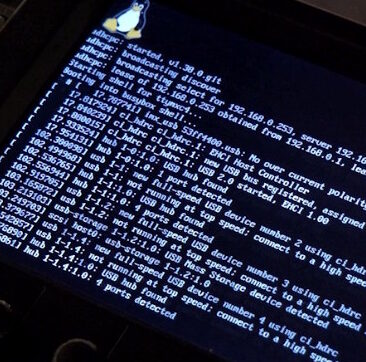
The OpenX32-project started with an initial GitHub-commit on 25th of May 2025. Within 9 month we managed to push the project from a very basic bootloader-environment to a feature-rich audio-mixing console with user-interface, audio-mixing-engine, effects, audio-routing and much more.
At the moment we have implemented around 60% of the original features of the X32. Here are some highlights we are proud to present:
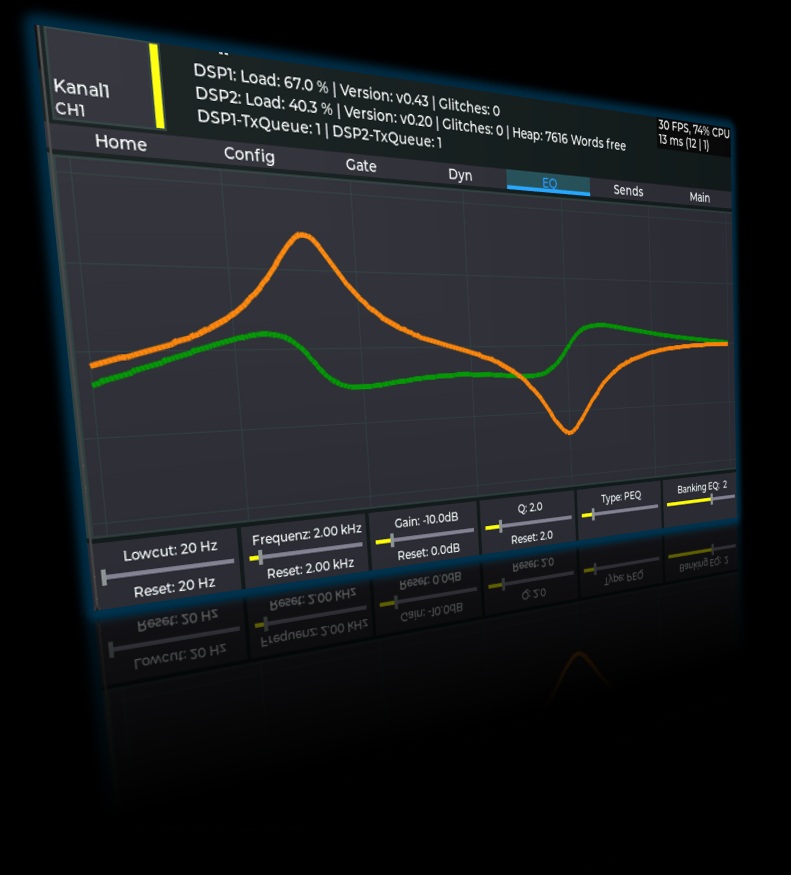
Several audio-related functions are already working:
- Noise-Gate, EQ, dynamic Compression, Mixing-engine
- several effects are already available and selectable using C++ classes
- 160 individual audio-signals can be routed in hardware already
- 96 signals within the DSPs can be routed and selected
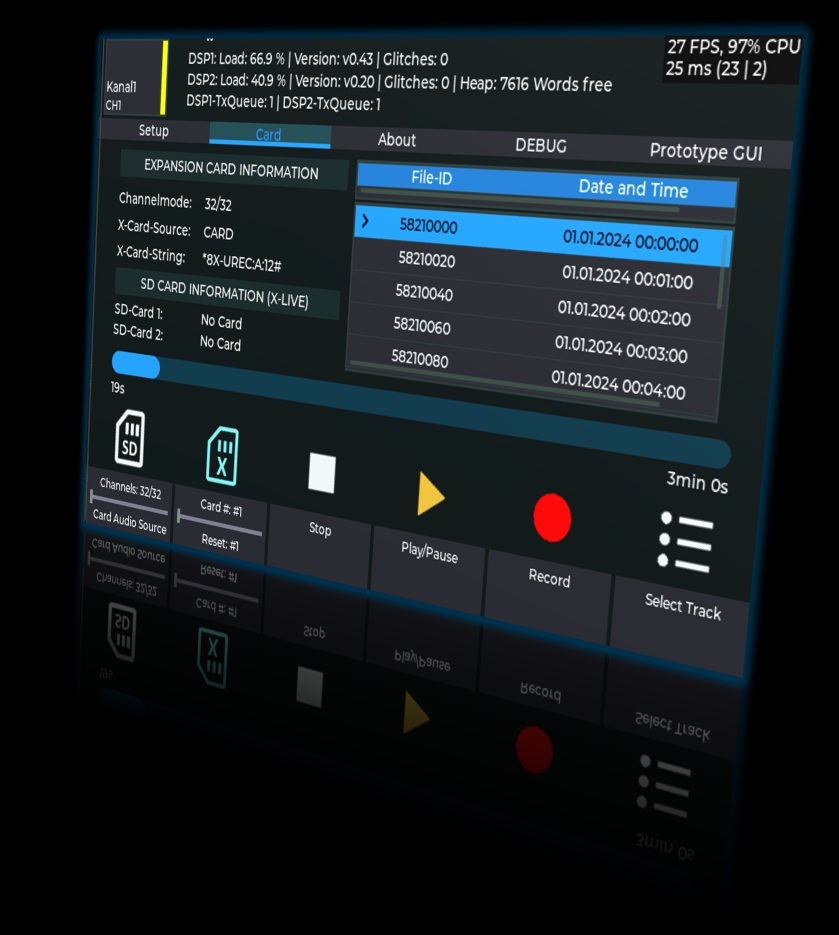
Some of the high-level-functions are implemented as well:
- playback and recording using the XLIVE-Card
- routing signals using a nice GUI
- meter-bridge
General functions
- Linux-Kernel in Version 6.18 (LTS) starts to shell using 800×480 display framebuffer
- main-programm „x32ctrl“ programmed in C++ with a nice user-interface based on LVGL 9.5
- Support of 100MBit ethernet network-support with DHCP
- Support of internal Realtime-Clock
- Support of USB-Host interface (HID-Keyboard, HID-Mouse, Mass-Storage-Devices, Joystick, Soundcard, etc.)
- Support of internal SD-Card to read MAC-Address and the general configuration
- Support of booting from USB and the internal SD-Card using the original DCP-Bootloader
Hardware functions
- Support of X32 surface (faders, buttons, LEDs, encoders) through x32ctrl-software for different models (Fullsize, Compact, Producer and Core, as well as M32-series)
- Support of internal 8-channel analog input- and output-cards including headamp- and phantom-power-control (up to 32 input-channels and up to 16 output-channels)
- Support of internal 8-channel AUX-AD/DA-Converter (CS42438 on older revisions, M8000 on newer revisions) (8 input- and output-channels)
- Support of X-UF, X-USB and X-LIVE expansion-card (32 input- and output-channels)
- Support of UltraNet-Output (16 output-channels)
- First implementation of AES50-protocol for a single port (48 input- and output-channels)
- Support of 1:1-routing of the available 208 digital inputs (32x XLR, 8x AUX, 32x Card, 40x DSP, 48x AES50) to 208 digital outputs (16x XLR, 16x UltraNet, 8x AUX, 32x Card, 40x DSP, 48x AES50)
General Audio functions
- Support of both AnalogDevices DSPs (ADSP-21371 SHARC DSPs) via internal SPI-interface
- General mixing-engine in DSP1, Effects in DSP2
- 32 channels with general channel-strip (LowCut, Gate, 4-band EQ, dynamic Compressor, Mixbus-Sends, Balance and Mainfader)
- 8 channels with reduced processing (AUX-channels)
- Support of free routing of 96 internal DSP-signals
Advanced Audio functions
- Implementation of a stereo-decompositing FFT-based stereo to 5.1 upmixing-algorithm based on the work of Sebastian Kraft
- Implementation of a high-quality reverb based on the design of Geraint Luff (Smithaudio)
- Implementations of user-selectable effects like an Overdrive, TransientShaper, Delay, Chorus, DynamicEQ and a MultibandCompressor (some of them in alpha/beta stage)
- More effects can be implemented either in the general FX-DSP using the C++ class-based structure or by replacing the DSP-bitstream on the fly during operation